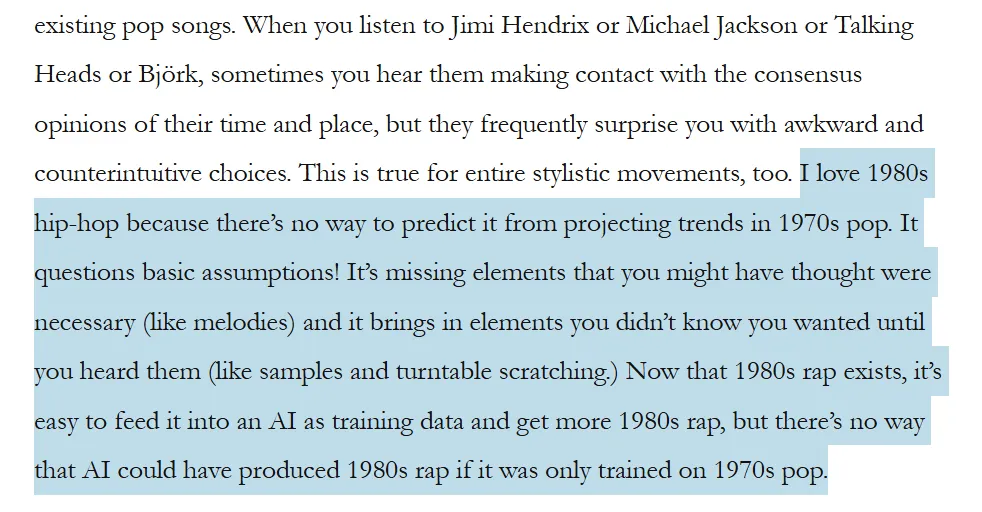
Hein states: “I love 1980s hip-hop because there’s no way to predict it from projecting trends in 1970s pop (…) but there’s no way that AI could have produced 1980s rap if it was only trained on 1970s pop,” highlighting AI’s inability to evolve and create genres. Looking back on Joop v/d Ende’s call to value culture as it is our soul in society, I realise we can also apply this ideal to the rise of AI art generation: to be aware of what we might lose. Thank you for reading this Hyve! :dj: (2/2)
Kars Van Schaik
Ethan Hein – AI slop predates AI
I would like to end this portfolio with a quote from this blog post by Ethan Hein, a music education teacher at NYU, also mentioned in Neely’s video essay (19:41). Fundamentally, an issue of AI art generation that possibly overshadows its complications with collaboration is its lack of soul. An argument for this is its inaptitude to innovate; AI generation can only mimic based on its trained data set, so essentially nothing entirely new can be created. (1/2)
Kars Van Schaik
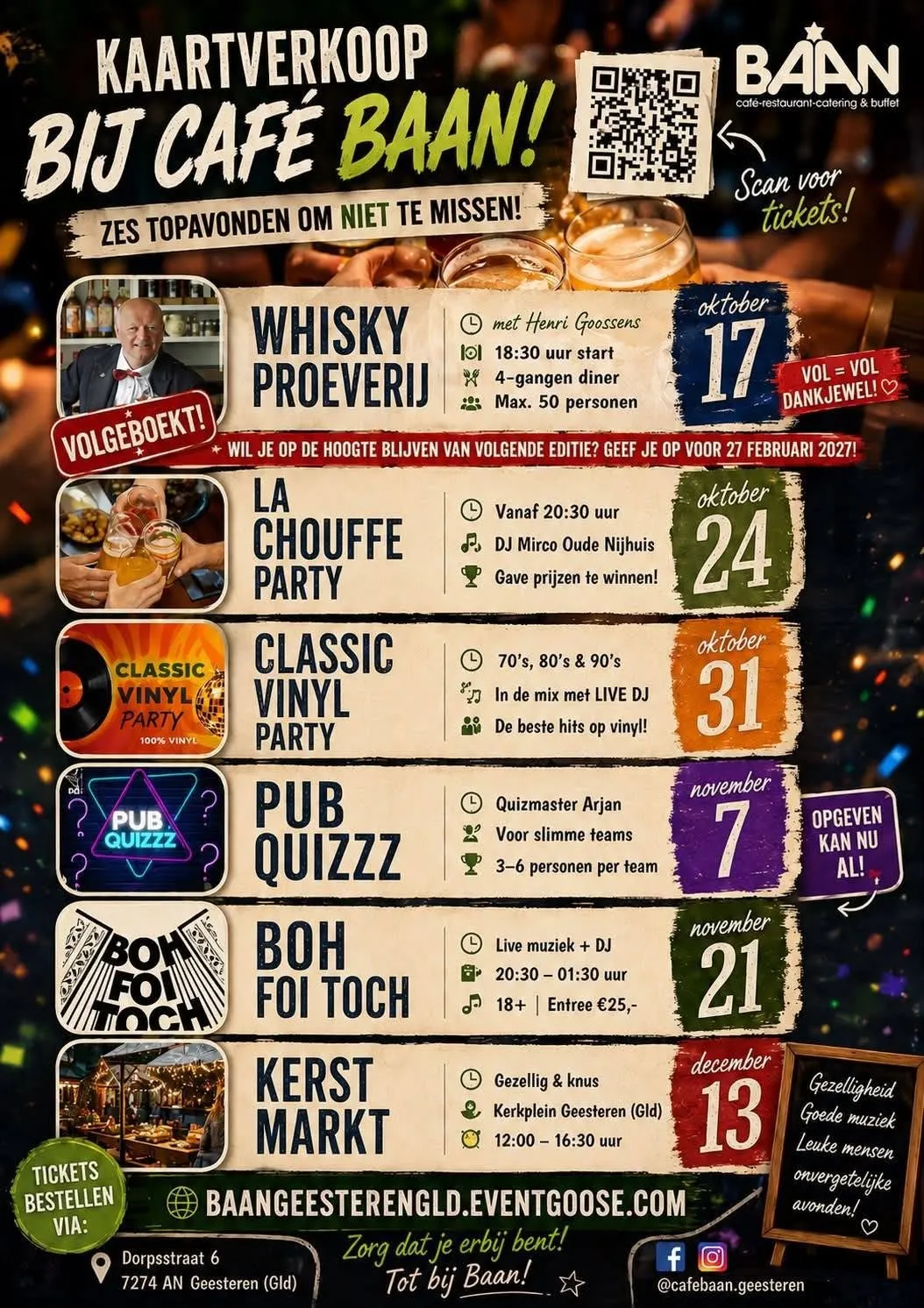
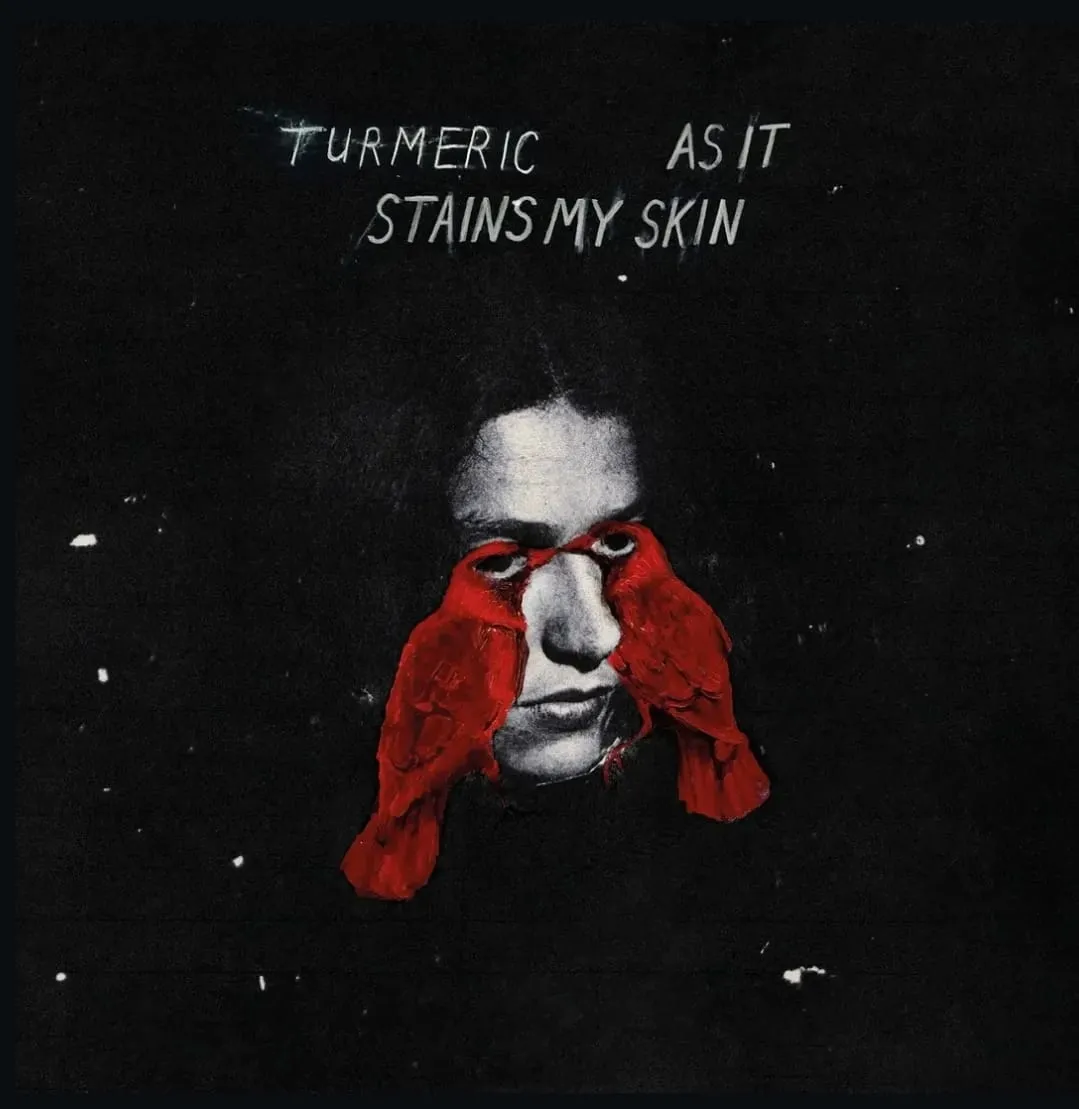
Visual artists lose work to actors who do it themselves. When I see AI-generated posters (you can easily recognise them by strange logic and dye-like fonts) I am instantly put off because you can sense a soul is missing. Furthermore, because people use similar AI programs, the outputs are always similar, which adds to that lack of uniqueness. Visual work can be elevated in meaning when real artists apply their effort and influence, like Sanne Korswagen with Turmeric’s album cover. (2/2)
Kars Van Schaik
AI Poster
Interestingly, I ended up thinking about AI, about its role in the field of music and its connection to collaboration. The coded interview and video essay both provided an interesting overlap in discourse on these topics. I kept my eyes open to any examples or connected ideas, and so I came across the new phenomenon of AI promotional posters like the one pictured here. In this case, AI threatens (interdisciplinary) collaboration as people outsource creativity to AI generation. (1/2)
Kars Van Schaik
AI can be seen as a collaborative actor Micha and Neely state, though an actor who provides a positive feedback loop. Neely states this may feed any “narcissistic tendencies” and threatens the soul that creating music with others should evoke. This reminded me of Micha and Janna talking about similar cases of people not being able to deal with criticism within bands, though they view it as a necessity to create collaborative art, again just like Bublitz et al. state conflict is needed. (3/3)
Kars Van Schaik
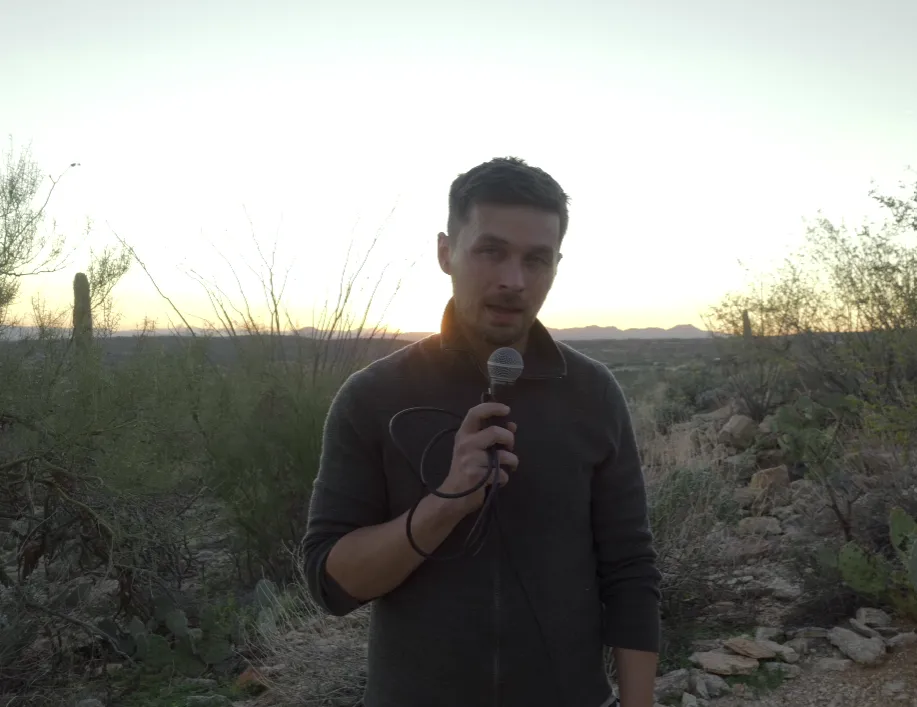
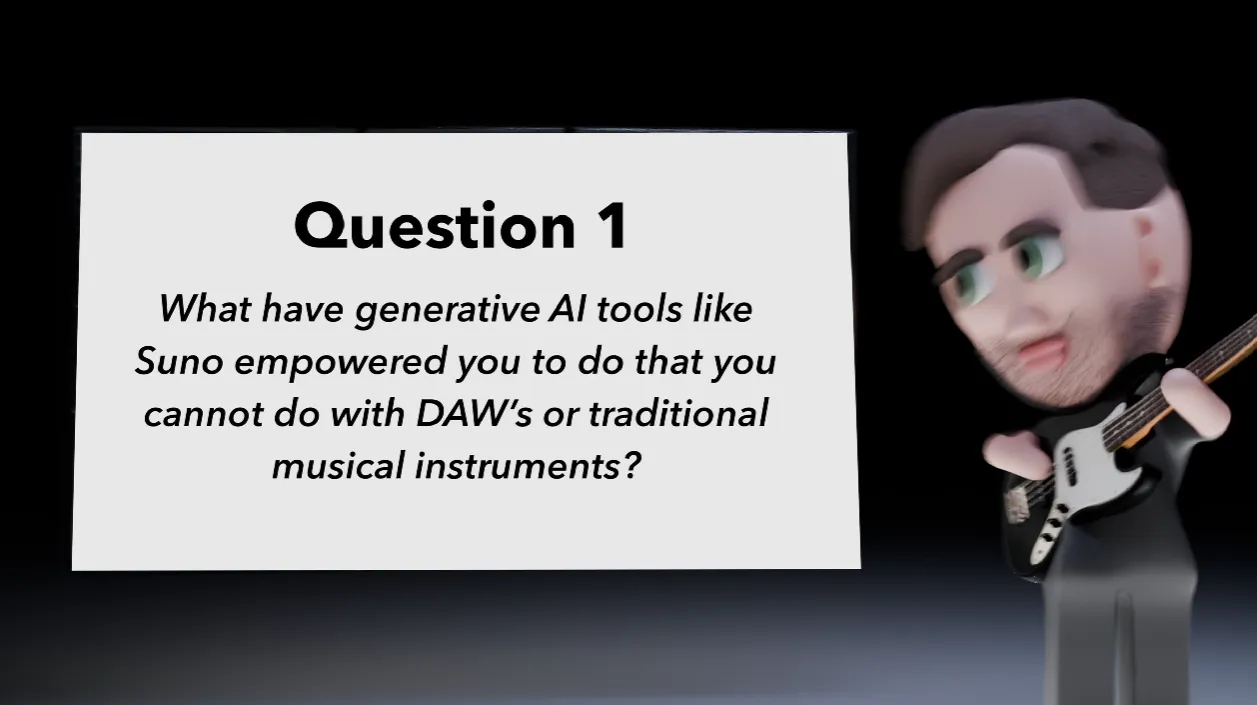
Neely asks three questions to his followers, including: “what have generative AI tools like Suno empowered you to do that you cannot do with DAWs or traditional musical instruments?” The answers to this question are that Suno facilitates creating music on your own, without the help of others and costs less time and money. Furthermore, people do not need to master any real skill to generate music; they do not need to fully master a real instrument. (6:55-24:16) (2/3)*
Kars Van Schaik
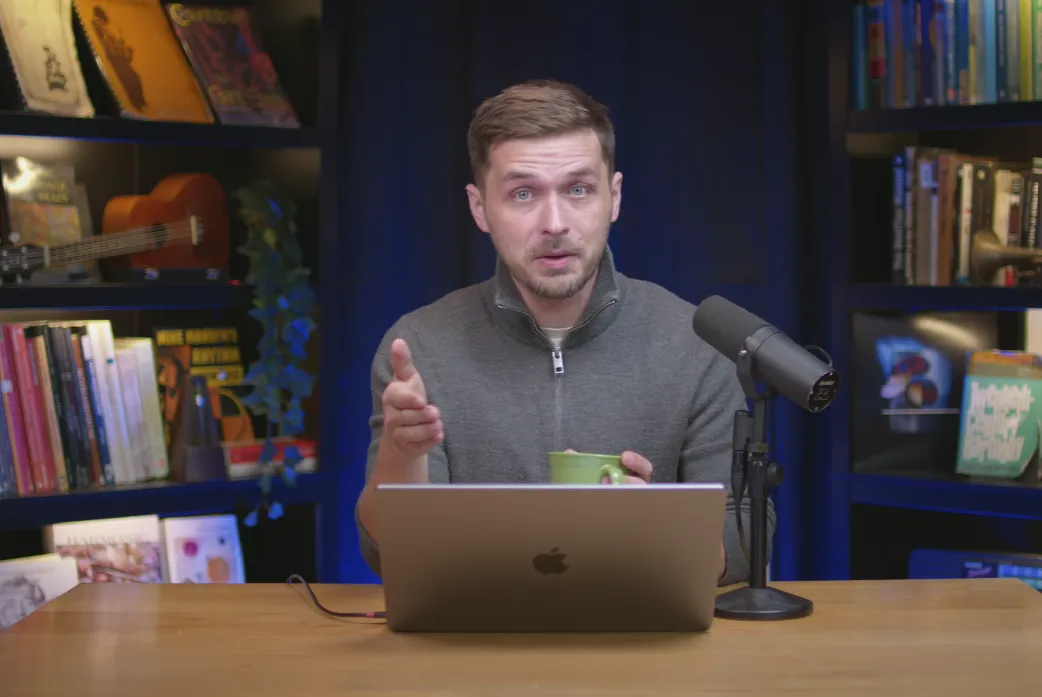
Adam Neely - Suno, AI Music, and the Bad Future
Regarding the bigger picture of AI in the field of music, Micha mentioned this video essay by Adam Neely (Youtuber and musician). During the interview we talked about ethical issues of stealing music and loss of soul when using AI to generate music, and this video essay seems to tap into those topics quite well. I decided to watch this video after we had done the interview and code a part of it as my second artifact. (1/3)
Kars Van Schaik
During the interview I also raised the topic of AI in music: you can use tools like Suno to generate songs or enhance your work. When I asked Micha, he said you could view such AI tools as collaborators, but it usually means you end up in a positive feedback loop as the AI always agrees with your genius. Part of collaboration, Micha states, is that you are being challenged and evolve from it together, much like Bublitz et al. seem to identify in conflicts as well. (4/4)
Kars Van Schaik
Interesting to me were our talks about collaboration. During the coding process I noticed there were ties with the three keys of collaborative art by Bublitz et al.: they collaborated with visual artist Sanne Korswagen from the Utrecht community for their artwork, document their progress on Instagram, and resolve tensions when they believe a change should be made: “[tr.] she made a first version (…) then we said ‘this is nice, and this should change’ and she did all of that.” (3/4)
Kars Van Schaik
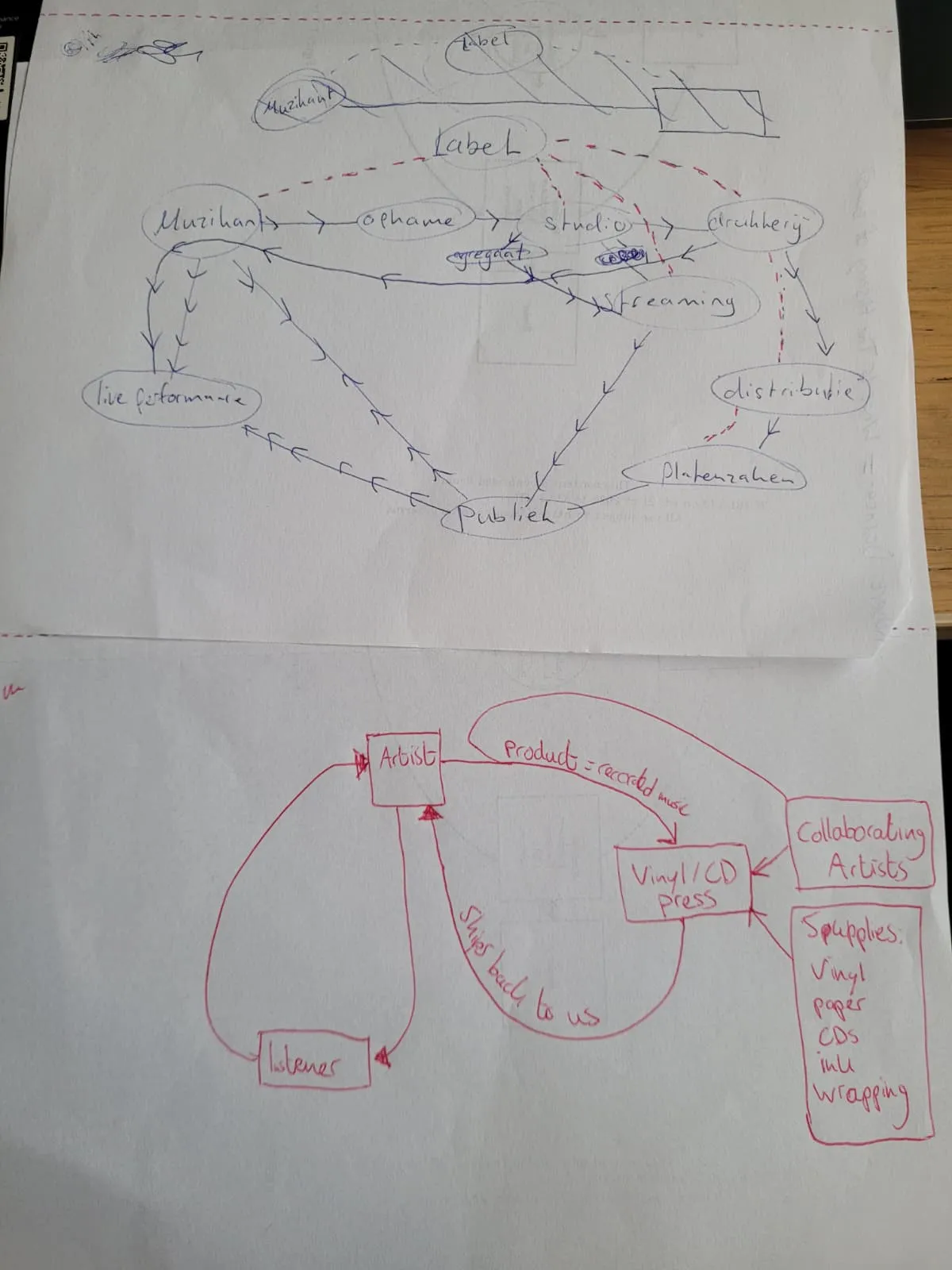
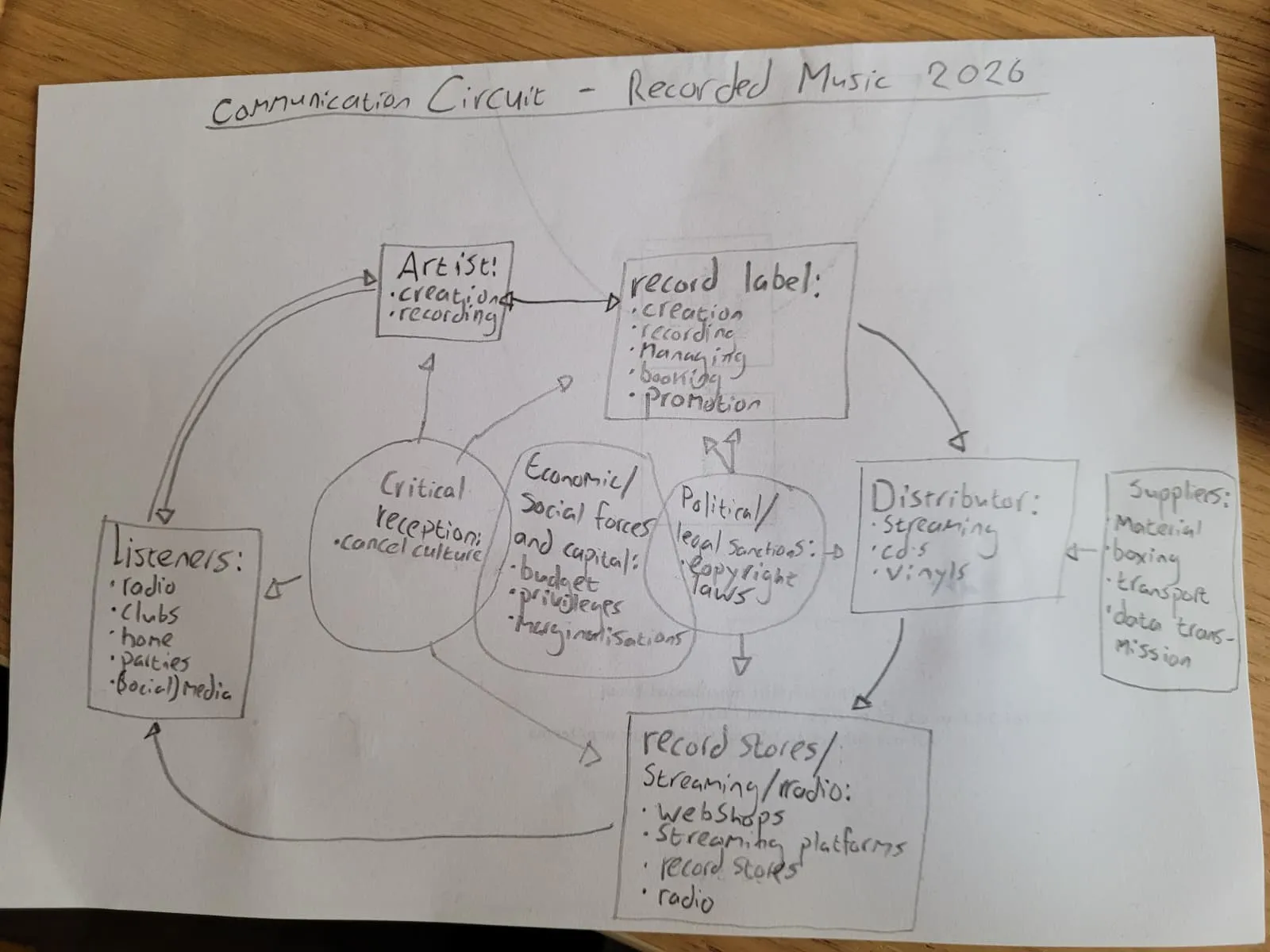
It was rather refreshing as Janna and Micha did not necessarily place themselves in a perfect circle after they drew. They do not have a label or big distributor and they do not use any major streaming platforms, so they rely heavily on live performance. All actors basically come back to/through themselves before they do anything with the output again. So vinyls are pressed by an external party, but they will be sent directly to Turmeric so they can distribute them themselves, for example. (2/4)
Kars Van Schaik
Interview Turmeric
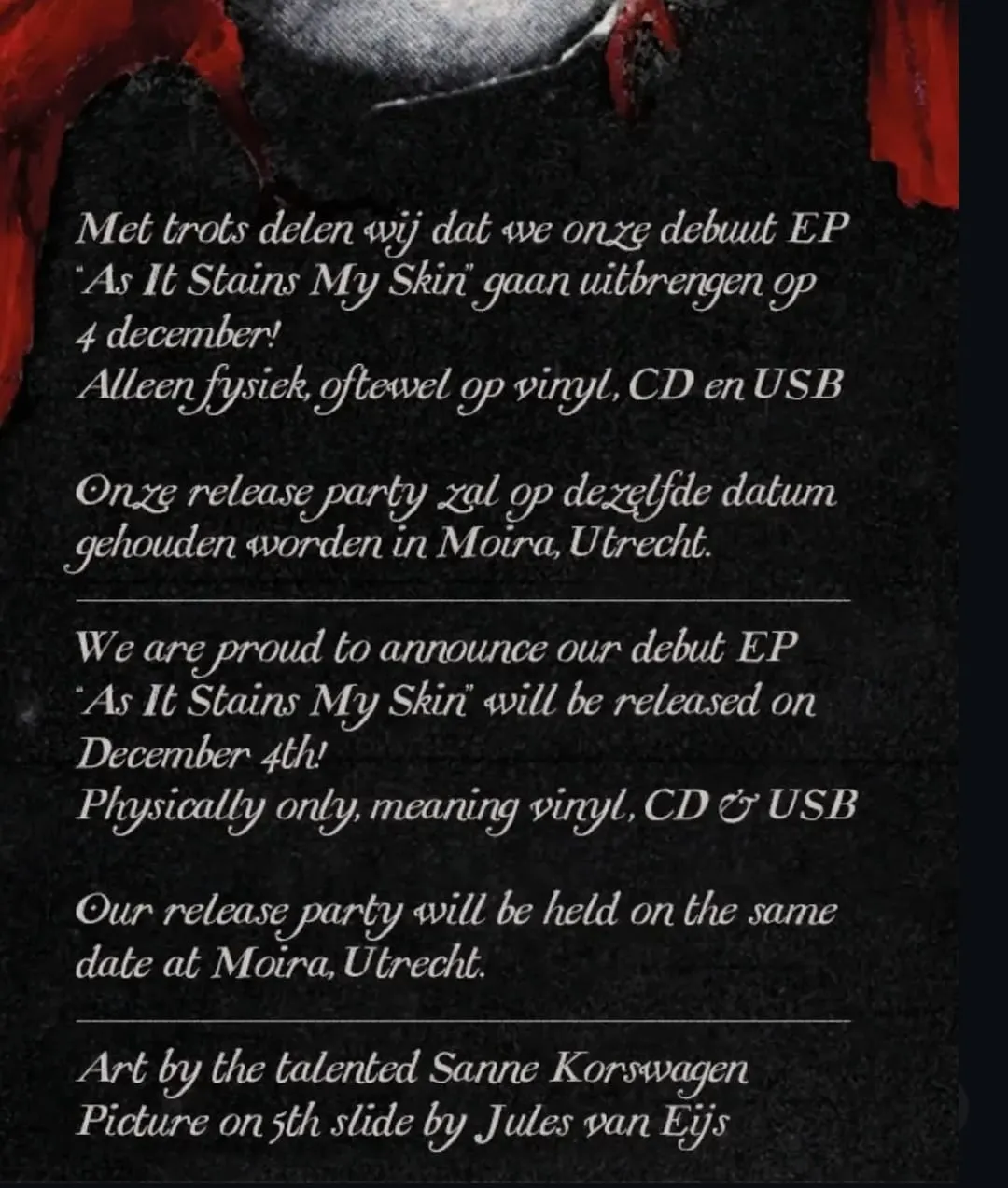
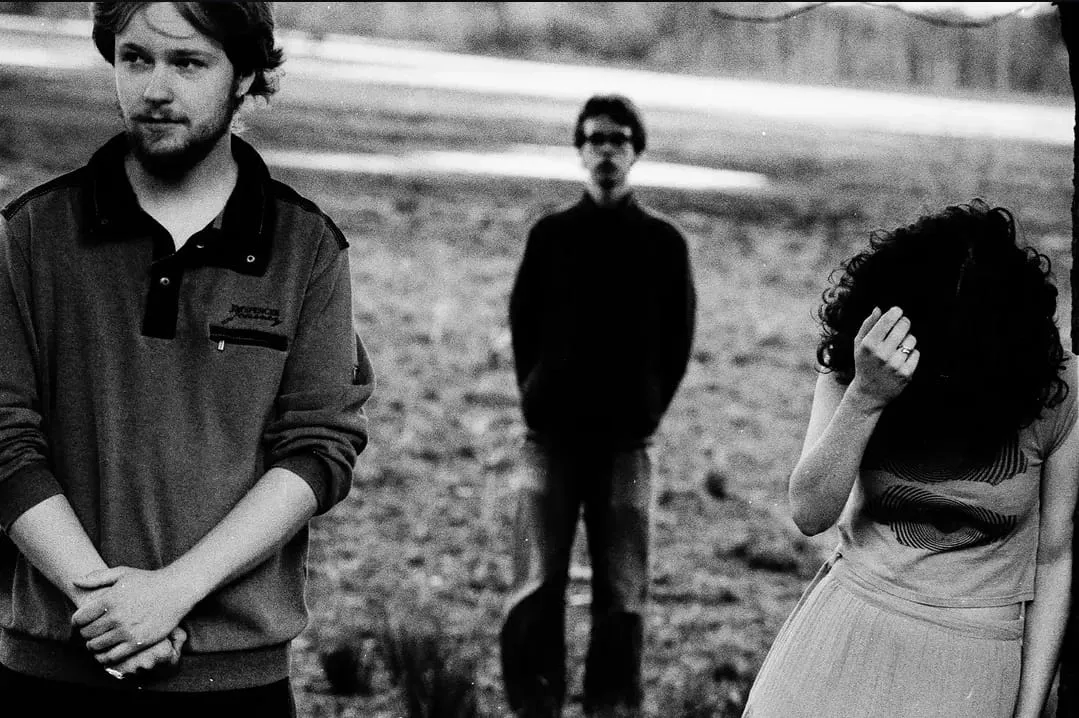
In my interview with Turmeric members Janna (24, bass) and Micha (22, guitar/vocals) I wanted to further explore and unpack these production cycles in the field of recorded music. As a young underground alt-rock band from Gelderland, I was curious to hear their experiences and opinions on their placement in the current field of music and their professional associations with the concept of collaboration. So, I asked if they could draw a production circle for their music (1/4)
Kars Van Schaik
Copyright laws determine artists cannot copy other people’s music, audiences and cancel culture can boycott artists for social issues, and economic capital may limit or expand artists’ artistic options. Personal privileges or marginalisations induced by society may further shape an artist’s work or identity. I believe artists can operate much more at an individual level than shown here, as I imagine a single association with listeners/audience is also possible nowadays. (3/3)
Kars Van Schaik
I sketched a relatively typical path pop musicians would take nowadays. Artists will sign up with a label who helps them create their art by recording, booking, promoting and in some cases even distributing. With distribution the music ends up in physical stores or online on streaming platforms. Through these actors listeners will access the new music who influence artists, and vice versa, as critical reception is key and economic/social/political influences further shape the music. (2/3)
Kars Van Schaik
Communicative Cycle with Recorded Music
I decided I would draw up a possible production cycle like Darnton’s in the context of recorded music in 2026. Designing such a cycle will help me determine which actors in the musical field interest me. As I studied musicology, worked at a music store and did an internship at a record store before, I am best acquainted with this discipline – naturally, my curiosity is driven towards the music field the most. (1/3)
Kars Van Schaik
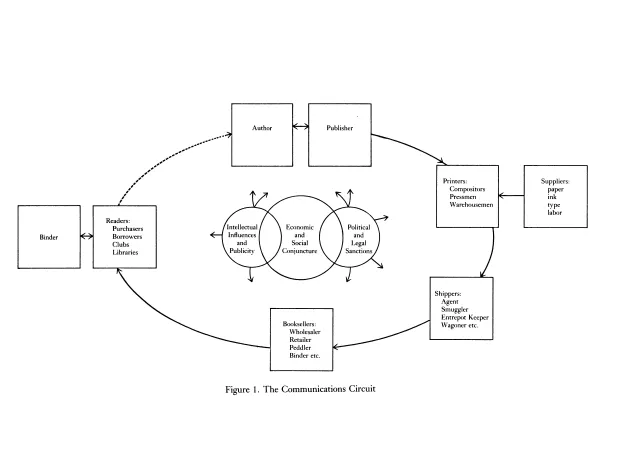
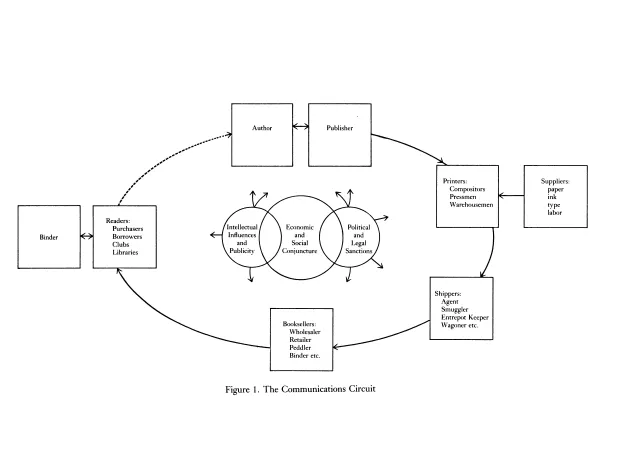
Several factors influence the outcome of this “communication circuit”, including social, economic and legal forces. For example: authors and publishers may think of their audiences’ wishes, their available capital, and what is politically or socially accepted to write about and publish. Darnton applied this model to Voltaire's Questions sur l'Encyclopédie, yet he states such a model can be applied to the production cycle of printed books from any period of time (69). (2/2)
Kars Van Schaik
Robert Darnton – What Is The History of Books?
At this point I want to dive deeper into the process of art production to explore all the different actors in the cultural field like: UIT, artists, residents etc. During class we discussed the text of Robert Darnton in which he sketches a production cycle of books: authors negotiate with publishers as the book is then printed and shipped to booksellers. Readers may finally buy the book and influence the authors, completing the cycle (67). (1/2)
Kars Van Schaik
UIT
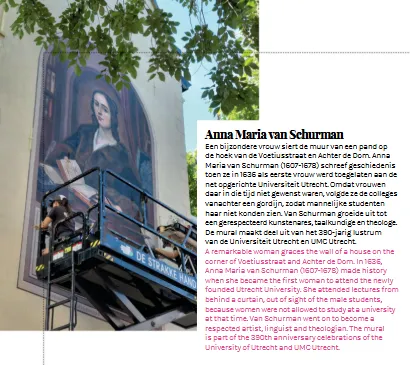
Back to human-to-human collaboration, I find all kinds in UIT. This monthly magazine collaborates by showcasing cultural activities around Utrecht. I always like reading UIT as the cultural content inspires me to reflect on or view art. Sometimes I will go to concerts in Tivoli or view collaborative art like the mural shown in the attached photo (10). Contributing to UIT, writing about cultural events and finding collaborative art, is definitely an internship option I want to consider now.
Kars Van Schaik
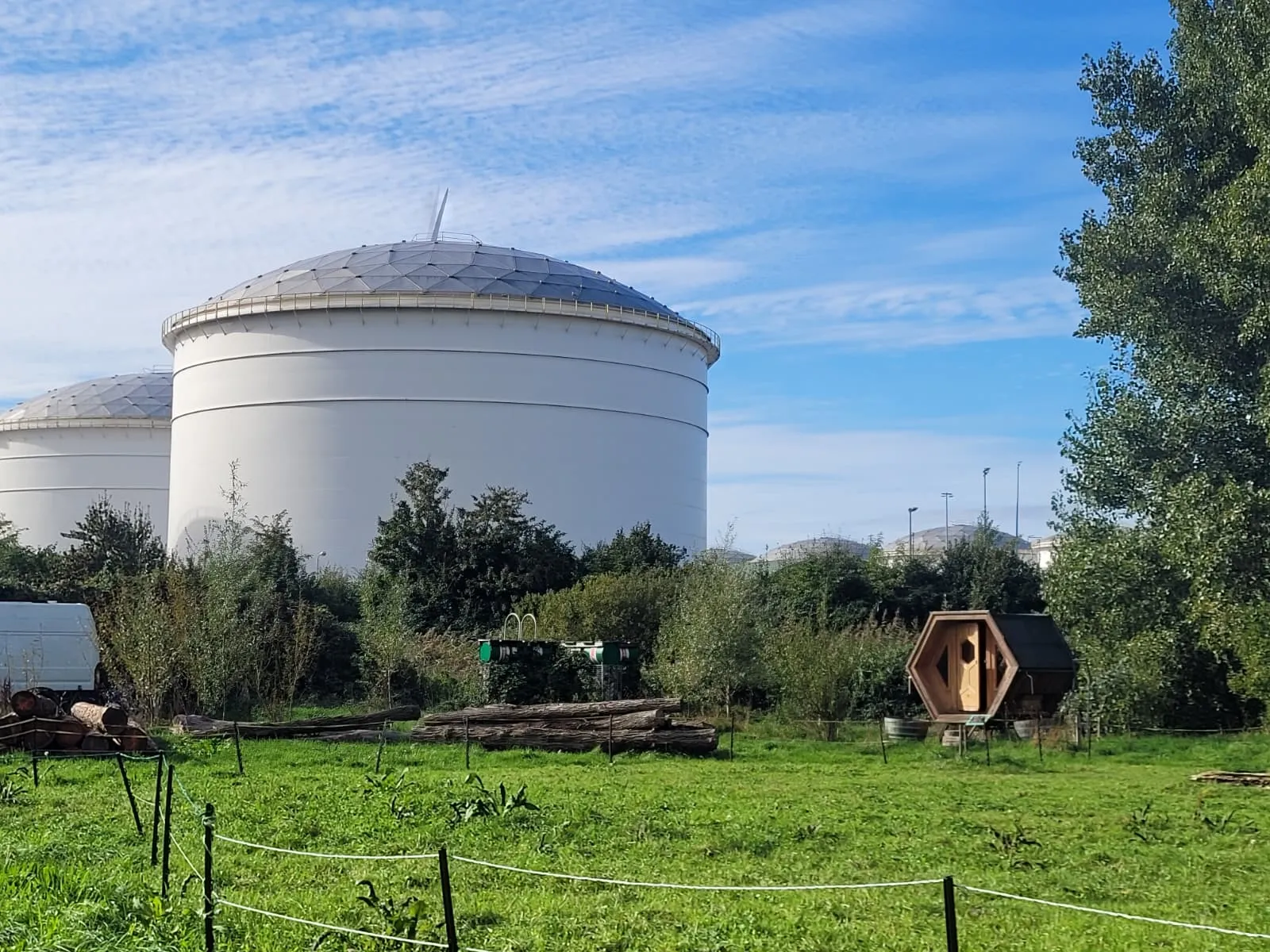
Such acts of cooperation are key in our arts and society. Imminently we work together in the context of our planet, so I believe we should also consider non-human actors in the cultural field. How can we bring awareness to climate crises, catastrophes, and highlight nature in our arts? I believe Beeingness does so by highlighting our cooperation with bees in local communities. Ruigoord is surrounded by fossil industries and its community thrives on every piece of green that is available. (2/2)
Kars Van Schaik
Jessica Segall – Beeingness
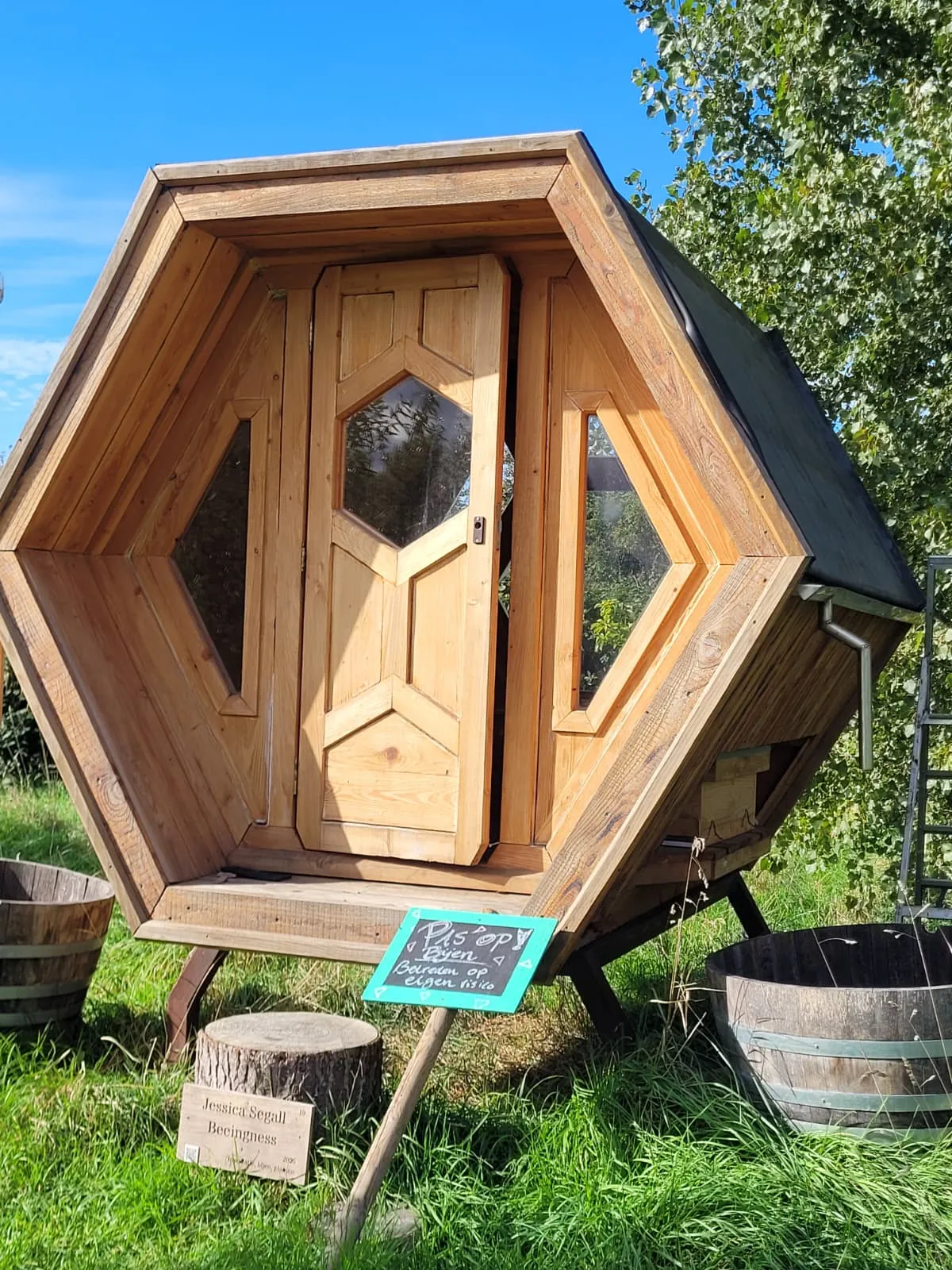
A collaboration of humans and nature is found in Beeingness at the artist village of Ruigoord. It is a cooperation between humans and bees. I worry about human neglect of nature and share this ideal of more human to non-human connections. The wooden comb-shaped hut provides a home to both species as two bee hives are attached to the outside walls and humans sit inside. The bee humming heard inside therapeutically calms the humans, relieving stress. (1/2)
Kars Van Schaik
I sense a different kind of collaboration that is more society than art focused; a little bit more distant from Bublitz et al. their theories. Still, I wanted to include this artifact to show my care for such community-based practices as it shows a participation of humans in collaboration with nature; an absent feature in the mentioned theory. When I walk through the city I sense we lose a touch with nature which I think is a shame. Let us remind ourselves of our connection to nature. (2/2)
Kars' Portfolio - Exploring A&S
Aangemaakt door@karsvanschaik
For my MA program at Utrecht University I will share my portfolio on this Hyves page. This portfolio consists of artifacts: art and society related (conceptual) explorations I did the past two months. Please enjoy and share your thoughts as you scroll, and may they inspire you in one way or another!